Artificial novelists

I just finished reading "The Girl in the Spider's Web", the fourth book in the Millennium Trilogy by Stieg Larsson, which was made into a great trilogy of films in its native Sweden, and (IMHO) a less good film by Hollywood.  Famously, this fourth book was not written by Larsson, who made the ill-advised career move of dying before his books became huge best-sellers. But (IMHO again) it's damn good. For me at least, the cast of characters live on. (There is an AGI sub-plot which I think is a bit daft, but it barely distracts.) The shift in author...
Calum Chace All articles

Book launch event for "Surviving AI"

Google kindly offered the use of the conference room at their London Campus for the official launch of "Surviving AI" on 15th September. David Wood, chair of the London Futurist Group did most of the organisation with his usual efficiency and aplomb, and Kenn Cukier of The Economist did a terrific job of compering. There was a great turnout and a lively discussion after the talk.  You can watch the video here, and you can join the discussion here.
Calum Chace All articles

Interview on Talk Radio Europe

Here's a link to a 14-minute interview with Bill Padley of Talk Radio Europe, a station for English-speakers in Spain.  A tiny bit of research enabled me to illustrate the power of the AI we already have, much to Bill's delight. [embed]https://youtu.be/Faao4DQI4Eo[/embed]
Calum Chace All articles

Review the Future – podcast interview

A couple of days ago I Skyped with Jon Perry, co-founder and co-host of the excellent Review the Future podcast. (I came across this podcast recently when they interviewed Nikola Danaylov of Singularity 1 on 1, and I've listened to some of their back catalogue, which I highly recommend.) Jon and I cantered over much of the subject area covered by “Surviving AI”, and then he edited it so that I didn't sound like a complete fool. (Thanks Jon!) And now it's online and available for your consideration.

"Surviving AI" is now available at Amazon!

"Surviving AI", a non-fiction review of the promise and peril of artificial intelligence is now on sale at Amazon.  It's available in both ebook and paperback formats, and my favourite voice artist, Joe Hempel, is making great strides with the audio version.  (Here are Amazon's UK and US sites.) Artificial intelligence is our most powerful technology, and in the coming decades it will change everything in our lives. If we get it right it will make humans almost godlike. If we get it wrong... well, extinction is not the worst possible outcome. “Surviving AI” is a concise, easy-to-read guide to what's coming, taking you...

Pandora's Brain is now available as an audio book

The audible version of Pandora's Brain is now available at your local Amazon store.  You can even get it free if you subscribe to Audible's subscription service. The narrator is Joe Hempel, a very talented voice artist based in the US (see previous post). In some episodes of Top Gear, the anonymous test driver The Stig listened to audio books while working.  I wonder if he now works for the BBC or for Amazon?  Anyone got his number?

Creating an audio book – by recording artist Joe Hempel

This is a guest post by the voice recording artist Joe Hempel - seen here with a dentist's best client. Joe has done a great job of voicing Pandora's Brain, which will shortly be available as an audio book, and he is currently hard at work on the audio version of  Surviving AI. Joe is a diligent and talented recording artist, and it's been a pleasure working with him. So I invited him to explain a bit about the process of recording an audio book. --- When the audition for Pandora's Brain popped up on ACX (Amazon's audio creation exchange), I...
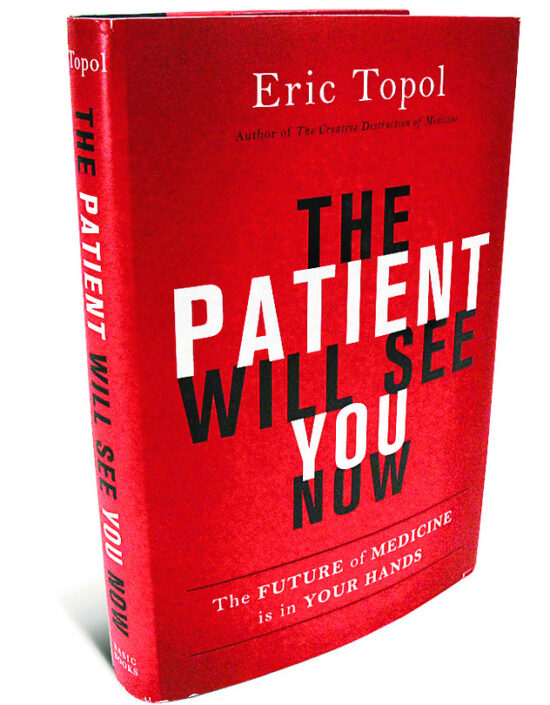
Book review: The Patient Will See You Now by Eric Topol

Book review: The Patient Will See You Now by Eric Topol

Eric Topol is a techno-optimist and a leading advocate of radical change in the medical profession. Judging by some of the reactions to this best-selling book, parts of that profession see him as a traitor. Smartphone revolution One of the two main themes in Topol's latest book is that the AI embedded in our smartphones is about to spark a revolution in healthcare. Paired with tiny sensing devices and accessing ever-increasing amounts of data, smartphone apps enable patients to monitor every aspect of our bodies.  Diagnoses can be made and prescriptions issued without us having to physically visit the doctor's...

Humanity’s capacity to believe fiction is our super-power

This may seem a bit off-topic, but bear with me. Yuval Harari's book "Sapiens" is brilliant.  I wish I'd written it.  It's stuffed full of great insights, large and small, and the writing style is crisp, clear and often witty.  You can sample his thinking in this TED talk: [embed]http://www.ted.com/talks/yuval_noah_harari_what_explains_the_rise_of_humans?utm_source=newsletter_weekly_2015-07-25&utm_campaign=newsletter_weekly&utm_medium=email&utm_content=top_left_image#t-875718[/embed] One of Harari's most important insights is that the reason why humans rule the world, and why the fate of every other species depends on us, is our ability to believe things that aren't true.  Our ability to believe that money is valuable, and that nations and gods exist is what enables us...

Endorsements for "Surviving AI"

"Surviving AI", a non-fiction review of the promise and peril of artificial intelligence, will be published later this summer.  Designer Rachel Lawston has produced a terrific cover (biased? me?), and I'm very grateful to all the illustrious (and busy) people below who gave their time to review it:  A sober and easy-to-read review of the risks and opportunities that humanity will face from AI. Jaan Tallinn, co-founder Skype; co-founder CSER and FLI Understanding AI – its promise and its dangers – is emerging as one of the great challenges of coming decades and this is an invaluable guide to anyone...

Artificial intelligence and ethics

I recently debated some of the ethical considerations raised by the rapid development of artificial intelligence with Ben Medlock of Swiftkey.  Sally Davies of the FT was the ringmaster, and the event was hosted by Playfair Capital.  The video is now available: [embed]https://www.youtube.com/watch?v=yvEpATeR5gA&index=1&list=PLDwFvHbYRUw2mcns9GXuGjJhkFD4JEyaQ[/embed]

Professor Margaret Boden’s talk at the Centre for the Study of Existential Risks

Professor Boden has been in the AI business long enough to have worked with John McCarthy and some of the other founders of the science of artificial intelligence. During her animated and compelling talk to a highly engaged audience at CSER in Cambridge last month, the sparkle in her eye betrayed the fun she still gets from it. The main thrust of her talk was that those who believe that an artificial general intelligence (AGI) may be created within the next century are going to be disappointed. She was at pains to emphasise that the project is feasible in principle, but she...

Technological unemployment

At an event to mark the launch of the FastFuture book, The Future of Business, I gave a short (8-minute) talk on the possibility that automation will create an economic singularity and lead to widespread technological unemployment. If that happens, will we be able to devise an economic system that can cope with some form of Universal Basic Income, and will we be able to get from here to there without social breakdown? Afterwards, Martin Dinov, Computational and Experimental Neuroscience PhD Researcher at Imperial College, gave a commendably clear talk on artificial neural networks. The video is here.  (The sound quality is not...

Future Trends Forum

Last week I was in Madrid, taking part in the 24th meeting of the Future Trends Forum, a think tank set up by BankInter, a leading Spanish bank. The subject was the Second Machine Age - organising for prosperity, and this short video was shot during the meeting: [embed]https://www.youtube.com/watch?t=12&v=-U5UIFgzAXM[/embed] The jumping-off point for the meeting was the eponymous book by Erik Brynjolfsson and Andrew McAfee, so a lot of the discussion revolved around automation and the possibility of widespread technological unemployment. The organisers brought together a fantastic group of smart, experienced people who worked together in a very open and collaborative way during the three...

New book: "Surviving AI". Review copies available

I've just finished writing a non-fiction book on artificial intelligence, called Surviving AI. It starts with a brief history of the science and a description of its current state.  It goes on to look at the benefits and risks that AI presents in the short and medium term, with a short story highlighting the improvements to everyday life that are in the pipeline, and discussions of technological unemployment and killer robots. Then it gets into artificial general intelligence - machines with human-level cognition: whether we can create one, and if so when; whether we will like it if we do, and what we should do about...

The Future of Business

I've contributed a chapter to an interesting new book about the future of business. Edited by Rohit Talwar, The Future of Business looks at the social and economic forces, business trends, disruptive technologies, breakthrough developments in science and new ideas that will shape the commercial environment over the next two decades. It contains chapters by 60 authors -  established and emerging futurists from around the world - and is grouped into ten sections: Visions of the Future - What are the global transformations on the horizon? Tomorrow's Global Order - What are the emerging political and economic transformations that could reshape the environment for society and...

Professor Stuart Russell's talk at the Centre for the Study of Existential Risks

Professor Stuart Russell, computer science professor at University of California, Berkeley, gave a clear and powerful talk on the promise and peril of artificial intelligence at the CSER in Cambridge on 15th May. Professor Russell has been thinking for over 20 years about what will happen if we create an AGI – an artificial general intelligence, a machine with human-level cognitive abilities. The last chapter of his classic 1994 textbook Artificial Intelligence: A Modern Approach was called “What if we succeed?” Although he cautions against making naive statements based on Moore's Law, he notes that progress on AI is accelerating in...

The Economist’s curious articles on artificial intelligence

The Economist is famous for its excellence at forecasting the past and its weakness at forecasting the future. Its survey on AI (9th May) is a classic. The explanation of deep learning is outstanding, but the conclusion that we should not worry about superintelligence because today's computers have neither volition nor awareness is, well, less impressive. The magazine's leader seems to agree, saying that "even if the prospect of what Mr Hawking calls “full” AI is still distant, it is prudent for societies to plan for how to cope". But it then goes on to make the outlandish claim that...